Posts

Showing posts with the label Research

Disparate circuits underlying time perception

This 2011 Journal of Neuroscience paper [1] show dissociation between relative beat based timing localized to striatum and absolute duration based timing localized to cerebellum. Given this dissociation , I'm not convinced that olivo-cerebellar absolute timing framework subserves or finesses the striatal relative timing framework as proposed in the 2014 Frontiers papers [2]. Further evidence against the unified model is from the 2010 PNAS paper [3] on cerebellar atrophy patients (SCA-6) which shows intact beat based timing abilities but deficient ability for absolute duration estimation. If unified model of time perception is indeed correct then why does cerebellar atrophy spare beat based timing abilities and why is there a dissociation between the two timing mechanisms in fMRI? Further, there is no mention of SCN - suprachiasmatic nucleus -  which tracks day-night cycle.  So I think the two timing circuits are not unified but disparate mechanisms.   References : [1...

Open Research Prize

Image
I was nominated for 'Open Research Award' 2024 from Newcastle University for my leading contribution in making 15+ software and 4+ datasets from Auditory Cognition Group as open source. The Open Research Awards recognises colleagues and students who have used open practices to make research more accessible, transparent or reproducible, and demonstrate an understanding of the aims of open research. Reference: [1] Open Research Award Winners -  https://www.ncl.ac.uk/library/academics-and-researchers/research/open-research/awards/

14th Summer School on ‘Brain Disorders Research’

Image
The annual Summer School on ‘Brain Disorders Research’ [1] is organised by Centre for Neuropsychiatric Genetics and Genomics (CNGG) [2], Cardiff University. This year the fourteenth edition of the summer school was held on July 8-11, 2024 in Cardiff, Wales. Here, I am documenting brief learnings and my reflections on participating in this summer school. The participants consisted of both students and researchers from neuroscience, and bioinformatics background as well as clinicians who were mainly trainee psychiatrists. We had participants from as far as HongKong and China who came to the UK just to participate in this program.  Given this heterogeneous mixture in the audience, the organisers ensured that sufficient background information is shared before introducing new topics be it neuroimaging or genomics. Since I do not have a background in bioinformatics, this introductory information on it was very important to understand and relate to the state of the art research findings t...

Time Window

Image
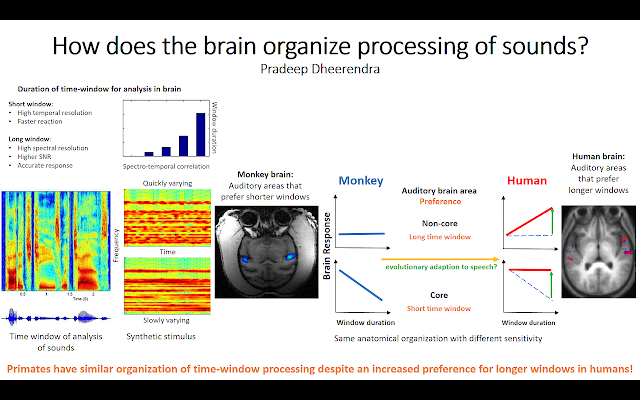
All natural sounds including animal vocalisations have distinct temporal structure consisting of individual segments with variations over time that are either slow or fast. The ability to extract, represent, and detect an acoustic feature depends on the time window used for processing the acoustic signal. A short analysis window provides higher temporal resolution while a long analysis window provides higher spectral resolution. This aspect of auditory perception is ethologically important since fast and accurate response to acoustic stimuli is critical to the survival of many animals, for instance their ability to hunt prey and avoid predators.

Understanding speech in noisy environment

Image
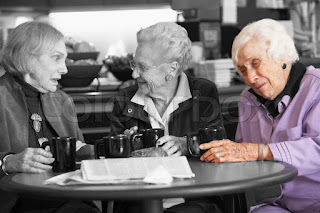
More than half the world's population above the age of 75 years develop age-related hearing loss. They report difficulty understanding speech in noisy environments which is a critical everyday task, like when listening to someone speak in a noisy cafe. But the ability to understand speech amidst background noise varies widely among people. Question : Why do some people struggle with speech perception in noise despite having clinically defined normal hearing?

How does the brain detect the appearance of new sounds?

Image
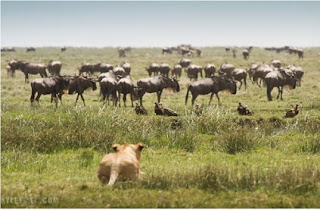
Our brain needs to perceive the world around us by hearing and recreating it in our mind. This requires that our brain has a way of identifying any new sound as it appears, separating it from other sounds that are present and finally representing it as a distinct object in our mind. An important question in understanding how the brain recreates an 'auditory scene' is therefore: how does the brain detects appearance of new sounds?

50years reviews on psychiatry

Image
To celebrate their 50 years, BNA has a huge number of reviews covering 'past, present, future' of many topics in neuroscience. Here is the link to a webpage with list of all published reviews. Link:  https://journals.sagepub.com/bna/past-present-future There are three reviews on psychiatric drugs and disorders. I list them below

Ancestry of Indians

Image
Do you know what is the ancestral origin of modern day Indians? Is it Arya(ns) or Dravidians? Did prehistoric Indians emigrate in large-scale towards the West spreading culture and language? Or did they immigrate and bring their language and traditions to the subcontinent? Are you curious to know the latest scientific findings on these questions? A recent paper [1] published in Science journal used ancient DNA to address these questions. Key findings :

Does GRE score predict research potential?

Image
Graduate Record Examination (GRE) score is essential aspect of graduate application for admission into postgraduate and doctoral programs in United States, and Canada. However, a pertinent question arises as to whether the GRE score can predict ability of the applicant to succeed in their doctoral studies? I recently came across a systematic study [1] which tried to answer this question. The summary of their key findings are below

How to summarize research

Image
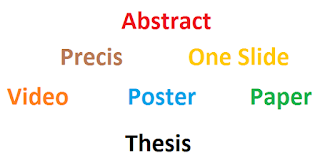
"You don't really understand something well enough if you cannot explain it cogently to your grandmother!" - Unknown For a scientist or a researcher, the ability to summarize a work to a target audience effectively and succinctly is an important and useful skill. However there are different media (text, video, image) for conveying the research, each medium with different word limits (100 to 100 thousand words) and targeted towards a different audience (general public to experts).  Here are the different media for conveying research that I discuss in this article: Abstract - max. 100 words - general audience Precis - max. 300 words - scientists but not from the field 1 slide - eqv. 1000 words - scientists from the field 3 minute video - eqv. 3000 words -  general audience Poster - eqv. 10,000 words -  scientists but not from the field Paper - max 30,000 words -  scientists from the field Thesis - max. 100,000 words - general audience I disc...

Science and society

Image
In my view, scientific progress primarily brings about betterment of society by improving the quality of life and providing access to modern healthcare. Though researchers strive to achieve breakthroughs hoping to translate these for public use, they implicitly assume that

Dream come true

Image
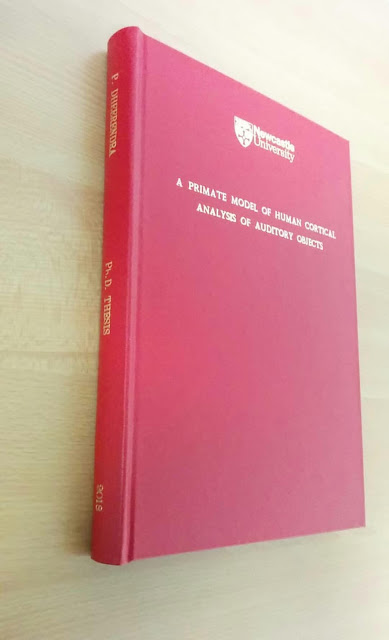
My childhood dream has finally come true. I was recently awarded PhD in Auditory Neuroscience by Newcastle University, UK. My thesis is titled "A primate model of human cortical analysis of auditory objects".  Here is a short summary of my work:

Metabolism of antipsychotic drugs in asians

Image
I was reading the NICE guidelines on "Consensus statement on high-dose antipsychotic medication", latest (2014) version. In the section on 'Potential gender and ethnicity factors and high-dose strategies' it says: Genetic polymorphisms at both the metabolic level and site of action are likely to contribute to the overall response to a particular drug. Some Asian patients might have a lower dose threshold for a variety of Extrapyramidal side-effects.

Research in Industry

I am happy to have suggested Mr Sundar rajan GS to interview Dr. Sitaram Ramachandrula, Senior Research Scientist, HP Labs, Bangalore. Here is an interesting interview with him on the topic "Research in the Industry". Q: Please give a brief introduction about you. SR: My name is Sitaram Ramachandrula, and I am a Senior Research Scientist in HP Labs India in Bangalore for last 5years. I have done my BE in ECE from Osmania university campus and M.Tech in Digital electronics from Cochin university campus and Ph.D in ECE from Indian institute of Science Bangalore with a specialization in speech recognition. Prior to working with HP Labs, I worked with Philips semiconductors and Philips consumer electronics divisions for nearly 5 years. Before that I had brief stints in Encore software and Ammanna technologies.

How to pursue research

Image
I am happy to have suggested Mr. Sundarrajan G S to interview Dr. Chandra Murthy, Professor , Electrical and Communication Engineering, Indian Institute of Science (IISc) Bangalore on the topic "How to pursue research" Here is the interview with  Chandra Murthy [CM] reproduced verbatim. The result is an wonderful insights into the thought process and view points of an academic. Q: A student has decided to do research – how do you suggest that he does a self analysis to really find out whether he is really interested in research? (peer pressure is common in colleges, so one might have resorted to research since his/her friends are into it.)