Posts

Showing posts with the label science

Glasgow Science Festival

Image
Glasgow Science Festival (GSF) returned for its 18th year, celebrating how research is transforming our lives, our cities, and our futures. GSF has over 150+ events spread across 40+ venues across the City of Glasgow, Scotland, UK.   As a part of Centre for Neurotechnology (CfN), on 9th and 10th Jun 2024 at Glasgow Science Centre, I engaged with the general public of all ages to demonstrate  Electroencephalography (EEG) based NeuroFeedBack (NFB) on volunteers who would wear a EEG headband and control their brain rhythm with a real-time visual feedback. This is an exciting application of Brain Computer Interface (BCI).

Is it only humans that count from left to right?

Image
How does one answer the question on whether animals, other than humans, count from left to right like us? The authors of this paper [1] come up with an ingenious way to test this. Here is their approach. Animals could be trained to interact with an object at a particular position in a long series of such identical objects for a reward. During training the series of objects need to be placed in such a way that counting from left to right or right to left requires interacting with the same object. This can be achieved by placing the series of objects sagittally - such that only one object (closest) is facing the animal and the rest are positioned along a single long column till the farthest object.  However, while testing the animal for directional preference, the series of objects need to be placed coronally - such that all objects are arranged facing the animal in a single row. Here counting from right to left or left to right results in choosing an object at different positions. T...

Does Rigveda convey the speed of light?

Image
In the commentary on the Rig Veda by Saayanacharya, a line translates as "Salutations to Sun-god who travels 2202 Yojanas in half a Nimisha". Some proponents interpret this to conclude that people during vedic age knew the accurate speed of light. We will now discuss the accuracy of this claim. This is how they come to this surprising conclusion.

Is Homeopathy scientific?

Image
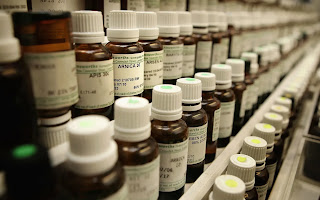
Any medicine has two ways in which it can bring about therapeutic effect - these are pharmacological means and psychological means. Let us analyse how homeopathic medicine acts. Pharmacological means refers to the biological action of the active

50years reviews on psychiatry

Image
To celebrate their 50 years, BNA has a huge number of reviews covering 'past, present, future' of many topics in neuroscience. Here is the link to a webpage with list of all published reviews. Link:  https://journals.sagepub.com/bna/past-present-future There are three reviews on psychiatric drugs and disorders. I list them below

Corruption in Pharmaceutical companies

Image
Johnson & Johnson marketed 'Risperdal' (tradename for Risperidone) using a strategy that downplayed the drug's side-effects, and provided kickback payments to nursing homes, but more importantly encouraged off-label use in children for behavioural disorders/autism and in elderly for dementia/sleeping against the explicit instructions from FDA. Ultimately, the fines for this conduct cost J&J $2.2 billion but they made $18 billion in profits from this drug alone and it enabled the then Risperidal sales manager, Alex Gorsky, to become current CEO of J&J but escaping individual culpability for devising such a strategy! Please watch the above (edited) video that covers Dr. John Rengen Virapen, Ex Director of Eli Lilly, one of the largest pharmaceutical companies in the world. This comes after his retirement, after working for 35 Years in that company. He now speaks out on the many crimes Big Pharma was and is responsible for (and he himself also participated ...

Ancestry of Indians

Image
Do you know what is the ancestral origin of modern day Indians? Is it Arya(ns) or Dravidians? Did prehistoric Indians emigrate in large-scale towards the West spreading culture and language? Or did they immigrate and bring their language and traditions to the subcontinent? Are you curious to know the latest scientific findings on these questions? A recent paper [1] published in Science journal used ancient DNA to address these questions. Key findings :

How to summarize research

Image
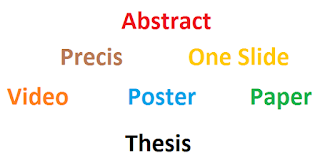
"You don't really understand something well enough if you cannot explain it cogently to your grandmother!" - Unknown For a scientist or a researcher, the ability to summarize a work to a target audience effectively and succinctly is an important and useful skill. However there are different media (text, video, image) for conveying the research, each medium with different word limits (100 to 100 thousand words) and targeted towards a different audience (general public to experts).  Here are the different media for conveying research that I discuss in this article: Abstract - max. 100 words - general audience Precis - max. 300 words - scientists but not from the field 1 slide - eqv. 1000 words - scientists from the field 3 minute video - eqv. 3000 words -  general audience Poster - eqv. 10,000 words -  scientists but not from the field Paper - max 30,000 words -  scientists from the field Thesis - max. 100,000 words - general audience I disc...

Science and society

Image
In my view, scientific progress primarily brings about betterment of society by improving the quality of life and providing access to modern healthcare. Though researchers strive to achieve breakthroughs hoping to translate these for public use, they implicitly assume that

Dream come true

Image
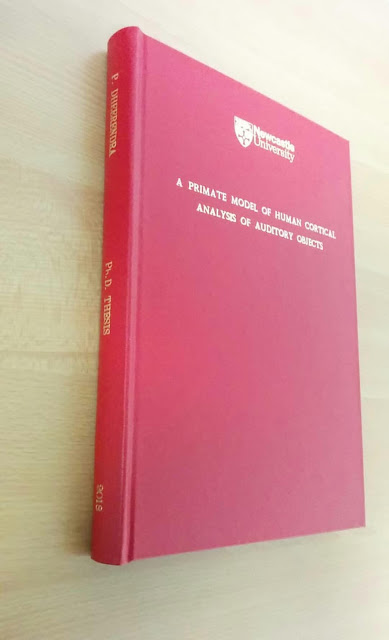
My childhood dream has finally come true. I was recently awarded PhD in Auditory Neuroscience by Newcastle University, UK. My thesis is titled "A primate model of human cortical analysis of auditory objects".  Here is a short summary of my work:

Sanskrit effect or Does chanting vedic mantra make you smart?

Image
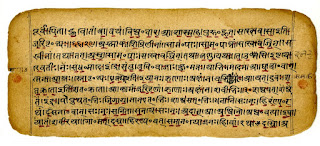
In a recent paper [1], that studied 21 professionally qualified Sanskrit pandits, it was discovered that memorising Vedic mantras increases the size of brain regions associated with cognitive function, including short and long-term memory. The term the ‘Sanskrit Effect’ was thus coined. In short, this study showed that

Are Randomized Control Trials suited for Mental Health research?

Image
Here are some limitations of using Randomized Control Trials (RCT) for Mental Health (MH) research. In the selection of people to RCTs, one needs to include subjects of a single condition or diagnostic category. However, in psychiatry the diagnosis can be unstable, changing, apart from secondary conditions, undiagnosed comorbid conditions. This also implies that the external validity of the RCT results are limited for MH.

Calculating distance to a pulsar

Image
How do we determine the distance to a pulsar? Background Pulsars are rapidly spinning and highly magnetic neutron stars that emit regular pulses of electromagnetic radiations e.g. Crab Nebula Pulsar in Orion constellation. Need Pulsars have been found in different star clusters and sometimes in other galaxies. By measuring the distance to the pulsar we can

International Spaceapps Challenge 2014

Image
The third annual International Space Apps Challenge will be held on the weekend of April 12-13, 2014. NASA has started accepting registrations to participate. NASA and other space agencies around the world are preparing for next edition of International Space Apps Challenge. The International Space Apps Challenge is an international mass collaboration that takes place in cities around the world. The event embraces collaborative problem solving with a goal of producing relevant open-source solutions to advance space exploration missions and improve life on Earth. NASA is leading this global collaboration along with a number of additional government collaborators and local partner organizations. If you are interested, you could participate either at

Sanskrit language

I came across an interesting article published in 1985 in the Artificial Intelligence magazine of Association for the Advancement of Artificial Intelligence ( AAAI ). This article titled "Knowledge Representation in Sanskrit and Artificial Intelligence" by Rick Briggs, from Ames Research Center, NASA talks about

A new model for scientific publication

In an article titled "Post-publication peer review: opening up scientific conversation", the inventors of and original advocates for open access now propose a radically new model of “publish first and then referee openly later” system. Faculty of 1000 ( F1000  London) where the author of this article belongs to, its remit is to work with named experts to identify and recommend the most interesting papers published across different subject areas in biology and medicine. Quoting the article, "Open access removes barriers for readers. Open, post-publication refereeing removes barriers for readers and authors alike, and it refocuses the role of peer review from, at its worst, a behind-the-scenes variety of censorship to, at its best, the process of expert criticism and advice that has always been its core and upon which the progress of science depends". What I liked most about the proposed model is its

Deciphering Indus Valley Civilization

Image
Indus Valley is the largest among all the ancient civilizations that existed around 4500 years ago, spread in region of what is now the modern day Pakistan, Afghanistan, and northern parts of India. Interestingly, Indus Valley Script is the world's oldest script that still remains undeciphered. Recently, I came across this awesome TED talk on "Computing a Rosetta stone for Indus Valley Script". Here is the link:  In this talk by Dr. Rajesh Rao puts forth his argument as to why the symbols represent a language script while disproving the claims of other research groups which say that those symbols do not represent a language script. Also read this excellent article by Dr.V.S. Ramachandran, brain researcher in California on plausible connections of Indus valley civilization with Easter Islands in Pacific ocean, a region unconnected geographically with Indus valley..! Quoting Voltaire, " No problem can withstand the assault of sustained thinking ". ...

How to pursue research

Image
I am happy to have suggested Mr. Sundarrajan G S to interview Dr. Chandra Murthy, Professor , Electrical and Communication Engineering, Indian Institute of Science (IISc) Bangalore on the topic "How to pursue research" Here is the interview with  Chandra Murthy [CM] reproduced verbatim. The result is an wonderful insights into the thought process and view points of an academic. Q: A student has decided to do research – how do you suggest that he does a self analysis to really find out whether he is really interested in research? (peer pressure is common in colleges, so one might have resorted to research since his/her friends are into it.)

Age of the universe

How do they calculate the age of the universe They use Hubble constant (Ho) to estimate the age of the universe.. But How Do They Do It..? This is how...