Posts

Showing posts with the label neuroscience

Disparate circuits underlying time perception

This 2011 Journal of Neuroscience paper [1] show dissociation between relative beat based timing localized to striatum and absolute duration based timing localized to cerebellum. Given this dissociation , I'm not convinced that olivo-cerebellar absolute timing framework subserves or finesses the striatal relative timing framework as proposed in the 2014 Frontiers papers [2]. Further evidence against the unified model is from the 2010 PNAS paper [3] on cerebellar atrophy patients (SCA-6) which shows intact beat based timing abilities but deficient ability for absolute duration estimation. If unified model of time perception is indeed correct then why does cerebellar atrophy spare beat based timing abilities and why is there a dissociation between the two timing mechanisms in fMRI? Further, there is no mention of SCN - suprachiasmatic nucleus -  which tracks day-night cycle.  So I think the two timing circuits are not unified but disparate mechanisms.   References : [1...

MMN as a biomarker in Chronic Pain

Chronic pain affects millions of people and remains extremely challenging to treat. Because of this, researchers are trying to find reliable signals in the brain that could help us understand chronic pain better and guide new treatments. One such signal is called mismatch negativity (MMN) — a small, automatic brain response that occurs when we hear an unexpected sound. In our review paper [1], we looked at all the published studies that examined whether MMN changes in people with chronic pain. After searching major medical databases, we found 17 studies, of which 7 met our criteria for detailed analysis. These studies included people with a variety of long-lasting pain conditions, and one study used a controlled method to create a long-lasting pain sensation experimentally. Most studies measured either the size of the MMN response or the speed at which it occurred. Three studies found that people with chronic pain had smaller MMN responses , suggesting the brain may be less efficien...

Do humans and monkeys listen to the world in the same way?

Image
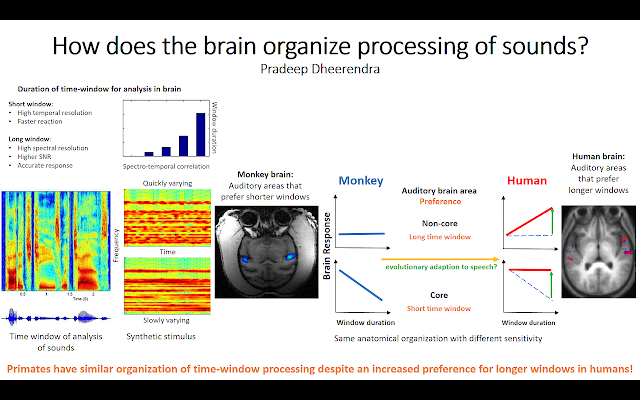
Have you ever wondered how the brain makes sense of the sounds we hear—speech, music, or everyday noises? My latest review paper looks at a simple but important question: do humans and monkeys listen to the world in the same way? It turns out they don’t. Humans tend to combine and interpret sound over slightly longer periods of time, while monkeys rely more on short, quick snapshots of sound. These “listening windows” shape how each species understands the acoustic world. Humans, for example, benefit from longer windows because speech unfolds over hundreds of milliseconds and relies on patterns that stretch across time. The review brings together many studies using brain scans, electrical recordings, and computer models. When you compare all the evidence, a clear pattern appears: the architecture of the human auditory brain has evolved to integrate sound over longer timescales than that of macaques or marmosets. This difference likely helped support the emergence of speech and other co...

BioMedical Engineering Conference 2025

Image
At BioMedical Engineering Conference 2025 held in Glasgow on Sept 4th to 5th, I presented my poster on whether Mismatch Negativity (MMN) is a marker of central neuropathic pain Intensity in Spinal Cord Injury (SCI) - these are results from a home-based pilot study. Abstract :  Cross-sectional studies have shown that pain affects brain activity in Central Neuropathic Pain. However, more studies are needed to establish if mismatch negativity (MMN) is a biomarker for pain intensity. This work aims to determine whether the changes in MMN, i.e., amplitude and latency, is predictive of change in central neuropathic pain intensity due to medication. In this longitudinal study, ten people with spinal cord injury-related central neuropathic pain recorded their response to MMN experiment using home-based self-guided EEG set-up for ten days both before and after taking medications over a period of several weeks. We found that the change in MMN was not predictive of change in central neur...

NeuroHack 2025

Image
I was selected to participate in Neuro-Hack, a 2-day hackathon powered by ARIA and organised by Nucleate UK. This took place on 28th to 30th Nov at London. The Hackathon brought together an interdisciplinary community interested in developing solutions for engineering a new generation scalable neuro-technologies. The Hackathon sought innovative ways to see, treat, or approach the brain. Key targets included non-surgical access, autonomous delivery, wireless therapeutic action, and non-invasive readouts.  So our product pitch in the competition entitled "Brain Pacer" was a non-invasive, adaptive brain-computer-interface using focussed functional UltraSound (fUS) for sensing and stimulation to deliver personalised neurological therapies. You can find our product pitch presentation here. I thank the organizers for selecting me for this hackathon and awarding me with a travel grant.

A promising avenue for treating Misophonia

Image
A recent study by Turrini et al [1] used cortico-cortical paired associative stimulation (ccPAS) - an non-invasive brain stimulation technique to manipulate brain connectivity achieved via network-based transcranial magnetic stimulation (TMS) - to alter effective connectivity in action observation network (AON) via Hebbian spike-timing-dependent plasticity (STDP). They showed that enhancing (or weakening) the connectivity between the ventral part of the PreMotor cortical area (PMv) and the primary motor cortex (M1) increases (or decreases) the tendency to automatically imitate the behaviour of others. They also showed that enhancing supplementary motor area’s (SMA) connectivity with M1 actually induces a greater ability to avoid imitation when it is inappropriate to the context. This provides us with a promising avenue to treat disorders of aberrant mirroring. Misophonia is a condition where people have extreme distress towards everyday bodily sounds like eating, chewing, breathing etc...

Is the iron dysregulated in the mirror neuron system in misophonia?

Image
In my latest paper, we hypothesize that in Misophonia (a condition characterized by intense emotional and physiological reactions to specific human-generated sounds) there is a self-perpetuating cycle of mirror system hyperactivity mediated by iron dysregulation. Here is the predicted pathological self-perpetuating cycle: Mirror system hyperactivity  →  Metabolic stress  →  Iron accumulation  →  Inflammation  →  Impaired inhibition  →  Involuntary mimicry. We suggest that therapies aimed at breaking this self-perpetuating loop may offer effective strategies for managing Misophonia. Reference : [1] Pradeep Dheerendra, Soumita Ramesh, "Is iron dysregulation in the mirror motor cortex associated with misophonia?", Medical Hypotheses, vol. 204, p. 111765, Nov 2025. https://doi.org/10.1016/j.mehy.2025.111765 Abstract : Iron homeostasis plays a critical role in brain function and mental health, yet its dysregulation in specific psychiatric conditions remains underexplored. In this ...

Closed Loop Neurotechnology Hackathon

Image
I was selected to participate in the UK's first 'Closed Loop Neurotechnology' Hackathon 2025 which took place on 26th and 27th June at Imperial College London.  The Hackathon challenge was to help people relax by increasing prefrontal alpha rhythm via closed loop auditory stimulation using Elemind's real world product that is meant for putting people to sleep. Our closed loop design was based on neural entrainment to amplitude modulated pink noise sounds whose AM frequency is at the peak of the alpha rhythm dependent on individual subject's EEG recording. We chose entrainment or resonant coupled oscillators model to increase alpha frequency since the communication delay between device and our Windows computer was too high on Python (even data loss) while on MATLAB it was 200-400ms variable delay. Under such conditions where delay is not constant and high, phase locked stimulation might back fire since it could decrease instead of increasing alpha power if mistimed. ...

Speech Entrainment in Schizophrenia

My latest paper in the Neuroimage: clinical journal assessed the impairments in neural entrainment to speech envelope in early stage psychosis. Impairments in language processing in Schizophrenia are a central aspect of the disorder but the underlying pathophysiology mechanisms are unclear. We tested the hypothesis that neural oscillations are impaired during speech tracking in early-stage Schizophrenia and in participants at clinical high-risk for psychosis (CHR-P). Magnetoencephalography (MEG) was used in combination with source reconstructed time-series to examine delta and theta-band entrainment during continuous speech. Participants were presented with a 5-minute audio recording during which they either attended to the story or word level. Theta-band entrainment in left Heschl’s gyrus, averaged across groups, was significantly lower in the STORY compared to WORD condition, and averaged over conditions, significantly lower in CHR-Ps, but intact in early schizophrenia patients, comp...

Explorathon 2024

Image
 As a part of Centre for Neurotechnology (CfN) team, on 21st and 22nd Sep 2024 at Advanced Research Centre, Glasgow University, I interacted with the general public of all ages at Explorathon 2024 event to demonstrate ElectroEncepahloGraphy (EEG which records electrical activity of the brain) and to celebrate 100 years of EEG. The audience got to wear portable dry electrode EEG headsets and were able to see neurofeedback in action.

14th Summer School on ‘Brain Disorders Research’

Image
The annual Summer School on ‘Brain Disorders Research’ [1] is organised by Centre for Neuropsychiatric Genetics and Genomics (CNGG) [2], Cardiff University. This year the fourteenth edition of the summer school was held on July 8-11, 2024 in Cardiff, Wales. Here, I am documenting brief learnings and my reflections on participating in this summer school. The participants consisted of both students and researchers from neuroscience, and bioinformatics background as well as clinicians who were mainly trainee psychiatrists. We had participants from as far as HongKong and China who came to the UK just to participate in this program.  Given this heterogeneous mixture in the audience, the organisers ensured that sufficient background information is shared before introducing new topics be it neuroimaging or genomics. Since I do not have a background in bioinformatics, this introductory information on it was very important to understand and relate to the state of the art research findings t...

Maths Inside 2023 winner

Image
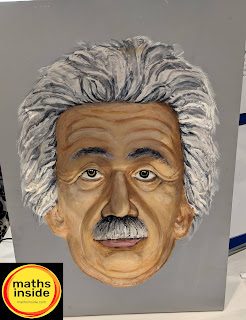
I won a prize for my photo submission entitled "Hollow Mask Illusion" under "the 'why' of shapes" category (adult level) in the "Maths Inside 2023" photo competition that aims to popularize scientific thinking in the general public. My submission discusses why people do not perceive the obverse side of a mask as a concave face but as a regular face instead. This illusion is robust in general and everyone can be surprised at this trick on the brain unless they suffer from Schizophrenia. Here is my winning photo and the caption. This image shows the obverse side of a mask that has been painted to showcase a face. When people see the reverse side of a mask, they are usually unable to perceive it as concave or a hollow face, but instead see a convex regular face as seen in this image. This illusion is a classic example of how brain uses its top-down expectations to shape visual perception. The "Predictive coding account of perceptual inference...

MMN in early psychosis

My latest paper published in Biological Psychiatry: CNNi journal aimed to assess whether Mismatch Negativity (MMN) is reduced in early stage psychosis. MMN is an event-related potential that occurs when repetitive sounds are interrupted by an occasional sound that differs in frequency or duration. Many studies have shown that patients with schizophrenia are impaired in this process. Moreover, there is evidence that MMN-deficits may be present in early-stage psychosis.  To investigate this possibility, we employed Magnetoencephalography (MEG) to establish whether MMN-responses are impaired in participants at 116 Clinical High Risk for psychosis and 33 First Episode Psychosis Patients compared with 38 psychiatric controls and 49 healthy controls. Contrary to our hypothesis, MMN-responses were intact, suggesting that MMN may not constitute a biomarker for early detection and diagnosis of psychosis. Reference : [1] Pradeep D, et. al., "Intact Mismatch Negativity Responses in Clinical ...

Does chanting OM relax the mind?

Image
In ancient Indian scriptures, specifically yoga philosophy, OM is considered a sacred syllable or mantra whose repeated prolonged utterance as in a form of meditation is associated with positive and beneficial effects on humans. What is the science behind it? Here are three studies that scientifically investigated the effect of OM chanting.

Understanding speech in noise

Image
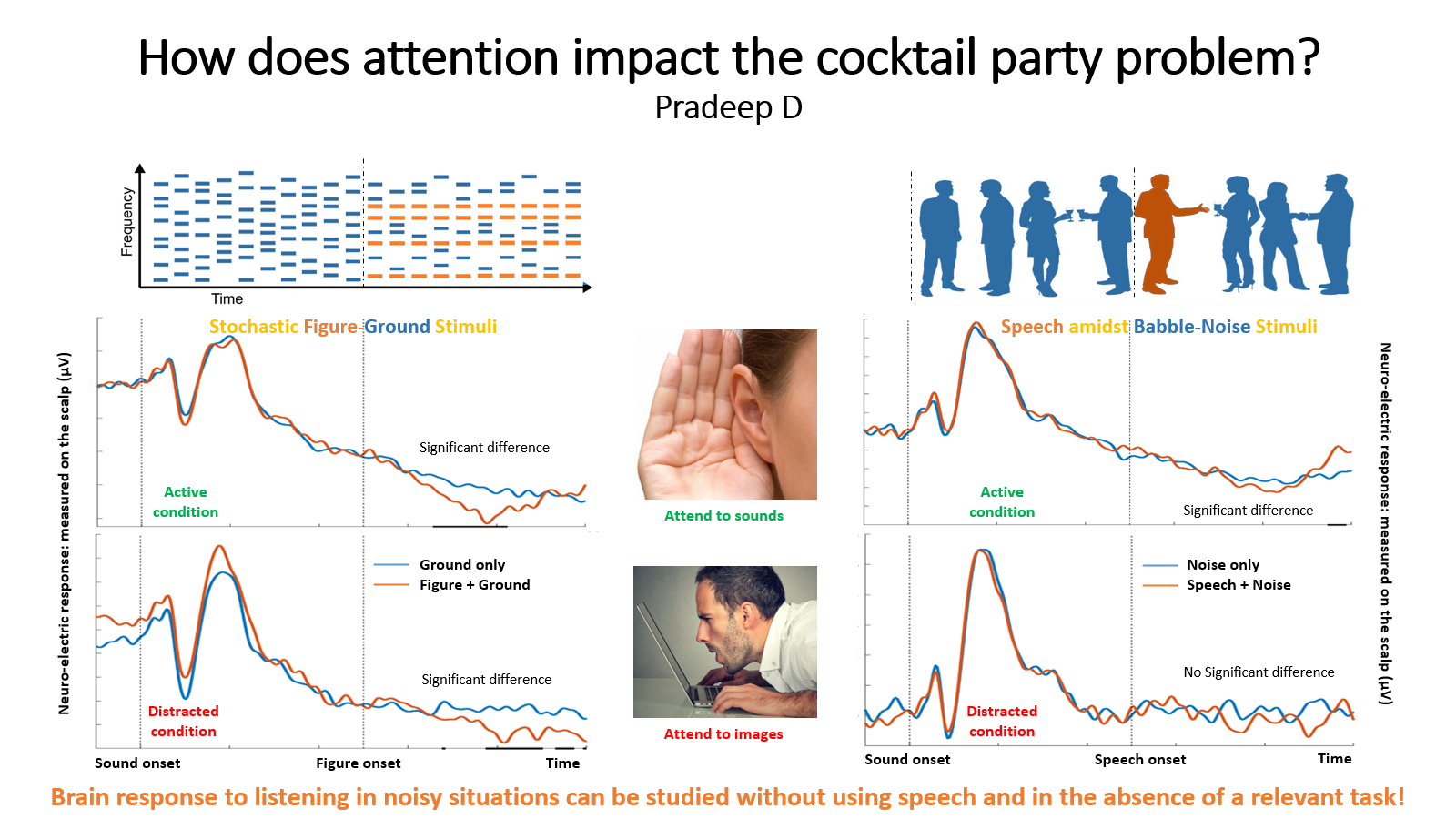
People with age-related hearing-loss commonly experience difficulty in understanding speech in noisy situations, like social gatherings e.g. cocktail parties, café, or restaurants.  Earlier scientific studies have established that the ability to segregate and group overlapping generic artificial sounds (not words in any language) is related to the ability to understand speech in social chatter. In my recent study [1], I non-invasively recorded electrical activity from the brain (using EEG technique) while the subjects performed a relevant task (sound segregation and grouping) and irrelevant task (a visual task). I compared the electrical signals evoked from the brain during segregation and grouping of non-linguistics artificial sounds against when trying to understand speech amidst (babble) noise. I established that the electrical brain activity generated during real-world listening is similar to that of artificial sound segregation done passively without paying atte...

Time Window

Image
All natural sounds including animal vocalisations have distinct temporal structure consisting of individual segments with variations over time that are either slow or fast. The ability to extract, represent, and detect an acoustic feature depends on the time window used for processing the acoustic signal. A short analysis window provides higher temporal resolution while a long analysis window provides higher spectral resolution. This aspect of auditory perception is ethologically important since fast and accurate response to acoustic stimuli is critical to the survival of many animals, for instance their ability to hunt prey and avoid predators.

Understanding speech in noisy environment

Image
More than half the world's population above the age of 75 years develop age-related hearing loss. They report difficulty understanding speech in noisy environments which is a critical everyday task, like when listening to someone speak in a noisy cafe. But the ability to understand speech amidst background noise varies widely among people. Question : Why do some people struggle with speech perception in noise despite having clinically defined normal hearing?

How does the brain detect the appearance of new sounds?

Image
Our brain needs to perceive the world around us by hearing and recreating it in our mind. This requires that our brain has a way of identifying any new sound as it appears, separating it from other sounds that are present and finally representing it as a distinct object in our mind. An important question in understanding how the brain recreates an 'auditory scene' is therefore: how does the brain detects appearance of new sounds?

50years reviews on psychiatry

Image
To celebrate their 50 years, BNA has a huge number of reviews covering 'past, present, future' of many topics in neuroscience. Here is the link to a webpage with list of all published reviews. Link:  https://journals.sagepub.com/bna/past-present-future There are three reviews on psychiatric drugs and disorders. I list them below

Corruption in Pharmaceutical companies

Image
Johnson & Johnson marketed 'Risperdal' (tradename for Risperidone) using a strategy that downplayed the drug's side-effects, and provided kickback payments to nursing homes, but more importantly encouraged off-label use in children for behavioural disorders/autism and in elderly for dementia/sleeping against the explicit instructions from FDA. Ultimately, the fines for this conduct cost J&J $2.2 billion but they made $18 billion in profits from this drug alone and it enabled the then Risperidal sales manager, Alex Gorsky, to become current CEO of J&J but escaping individual culpability for devising such a strategy! Please watch the above (edited) video that covers Dr. John Rengen Virapen, Ex Director of Eli Lilly, one of the largest pharmaceutical companies in the world. This comes after his retirement, after working for 35 Years in that company. He now speaks out on the many crimes Big Pharma was and is responsible for (and he himself also participated ...